If you've been treating your LinkedIn profile as a static résumé that happens to sit at the top of your org chart, this is the guide that changes that. Here's what executive branding on LinkedIn actually means, why the data says it matters more than most leaders assume, and a practical, step-by-step way to build it without turning into a full-time content creator.
What Is Executive Branding on LinkedIn, Exactly?
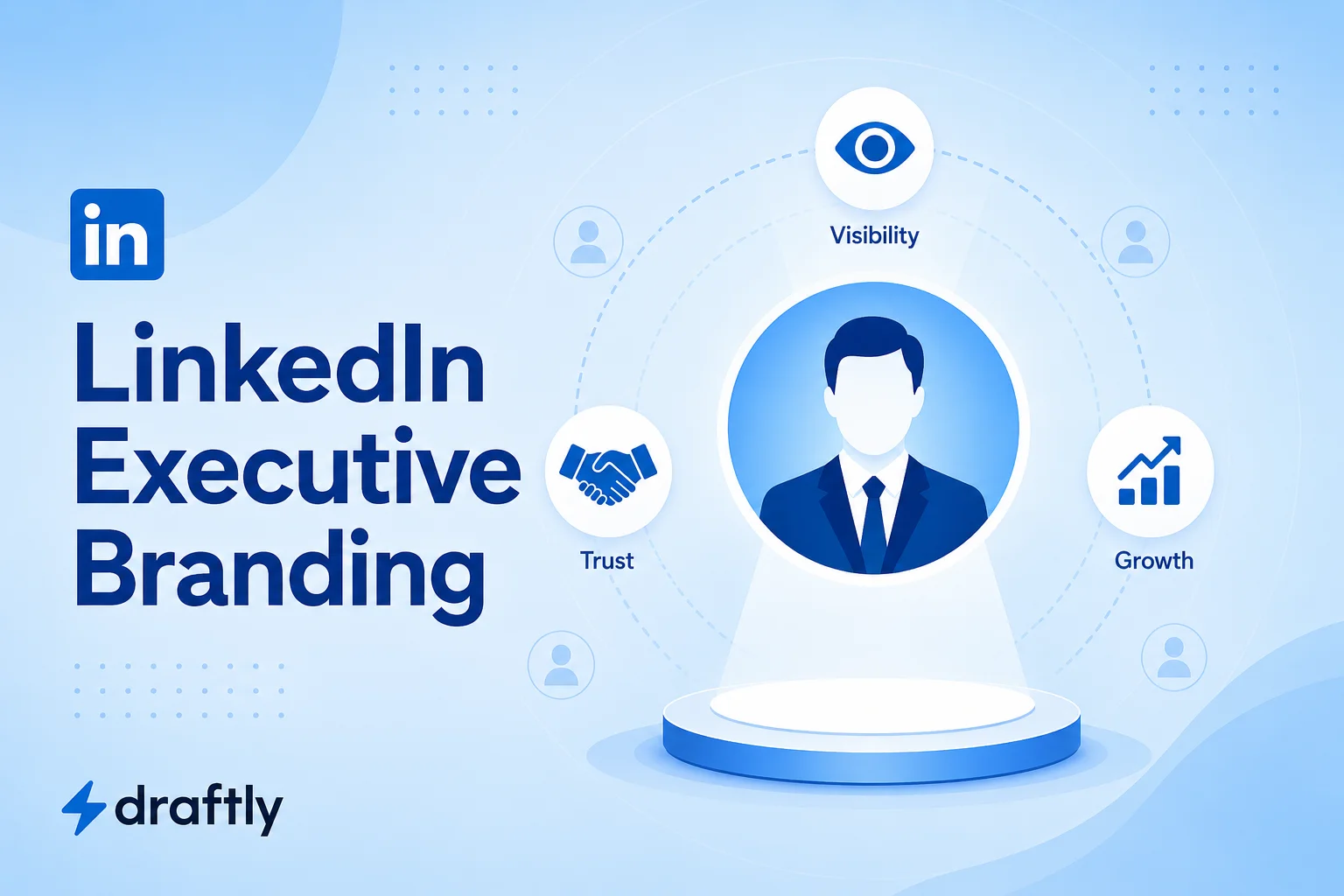
Executive branding is the deliberate positioning of a company leader, a CEO, founder, VP, or other senior figure, as a credible, visible voice in their industry, built primarily through their personal LinkedIn profile rather than the company page.
It's easy to confuse this with plain personal branding, and the mechanics genuinely overlap: positioning, profile optimization, consistent content, real engagement. But executive branding carries a different set of stakes. A mid-level professional's thin profile costs them a few missed opportunities. A leader's thin or outdated profile can cost a funding conversation, a board seat, a key hire, or the benefit of the doubt during a crisis, because for a senior leader, LinkedIn is often the first thing an investor, journalist, acquirer, or candidate checks before they ever take the meeting.
It's also different from running a strong company page. A company page broadcasts on behalf of a brand. Executive branding puts a real, specific person behind the message, and LinkedIn's own systems, along with most people's instincts, trust a person over a logo. That's why so much of what works here doubles as the foundation of building a personal brand on LinkedIn in the first place: if you haven't nailed the basics of profile clarity and consistent posting yet, that's the place to start before layering on the executive-specific stakes covered here.
Takeaway: executive branding isn't a fancier name for having a nice LinkedIn profile. It's a deliberate credibility asset that carries real business weight, good or bad.
Why This Actually Matters (The Numbers Say More Than You'd Think)
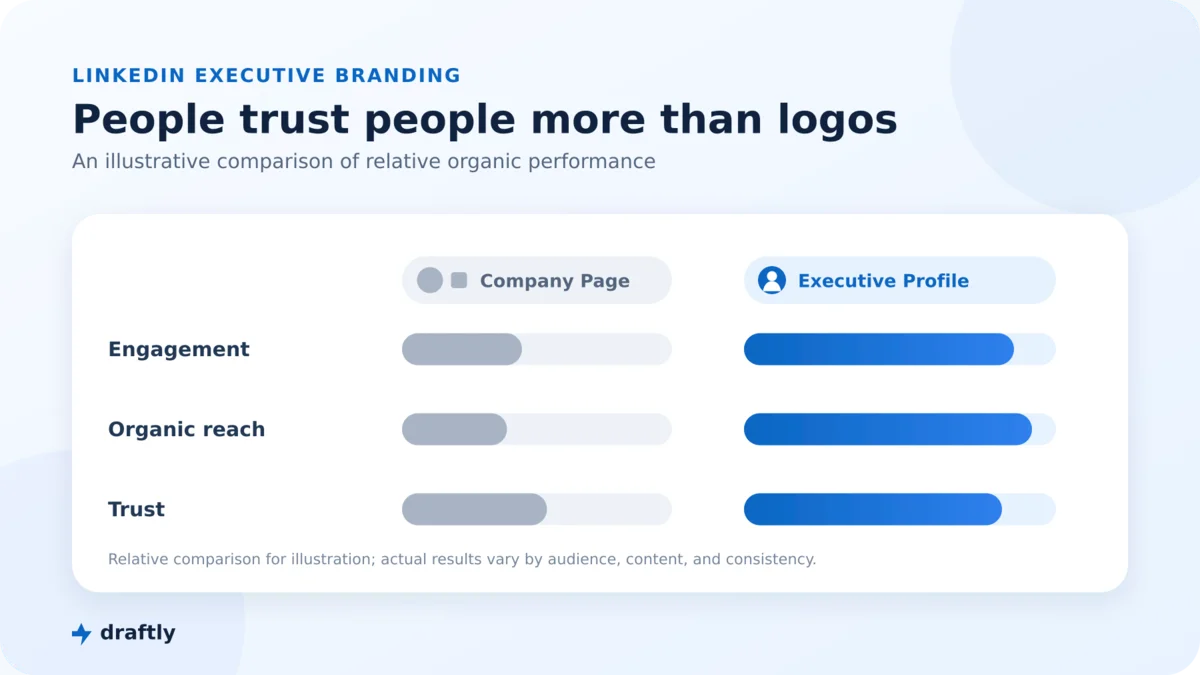
It's tempting to file "post more on LinkedIn" under nice-to-have. The research doesn't support that.
LinkedIn's own engagement data consistently shows personal profiles outperforming company pages by a wide margin. Recent platform-wide analysis found personal profile posts beat company page posts on engagement by well over 60%, with meaningfully higher comment rates per post, and executive-specific research has found leadership content generating close to seven times the impressions of an average user post. Separate research on B2B decision-making has found the large majority of B2B social leads trace back to LinkedIn specifically, and most B2B marketers name it their primary brand-building channel.
The recruiting and trust angle is just as strong. Studies on executive visibility have linked active, credible leadership content to faster hiring cycles and stronger candidate quality, and surveys on brand trust consistently find that professionals are considerably more likely to recommend a company after following one of its leaders on social media than after only following the company page. Executives who post with any real consistency also tend to see meaningfully faster follower growth and stronger brand association scores than peers who barely show up.
None of this means every leader needs to become an influencer. It means invisibility has a cost that's easy to underestimate, and consistency (not virality) is what actually moves these numbers.
Takeaway: the gap between a visible leader and an invisible one isn't a vanity-metrics story. It shows up in deal velocity, hiring, and how much people trust the company behind the name.
Executive Branding vs. Personal Branding: What's Actually Different
Since the two terms get used almost interchangeably, it's worth being precise about where they split.
- Audience and stakes. A freelancer's personal brand attracts clients. An executive's personal brand is being evaluated by investors, board members, journalists, and future hires simultaneously, often without the executive knowing which audience is watching on any given post.
- What "authentic" has to survive. A regular professional can experiment freely. An executive's posts get read as company positioning whether they intend that or not, so the margin for a careless take is smaller.
- Where support comes in. Most individual professionals write their own posts. Most executives, because of time constraints rather than laziness, lean on a content partner, a chief of staff, a marketing lead, or a dedicated ghostwriter, to turn their real opinions into drafts. The voice still has to sound like the person; they just rarely type every word themselves.
- What "winning" looks like. A personal brand often optimizes for followers and engagement. Executive branding optimizes for a narrower set of outcomes: qualified inbound, investor confidence, recruiting pull, and crisis-ready credibility.
If you're building this from scratch, clarifying your niche and content mix still matters almost as much as it does for any other professional: clear positioning, a focused content mix, and consistency over virality. What changes is the weight every post carries once your name and your company's are permanently linked in a stranger's mind.
Takeaway: the tactics barely change. The consequences of getting them wrong do.
How to Build Executive Branding on LinkedIn: A Practical Framework
Step 1: Define a Point of View, Not a Job Title
The single biggest structural mistake executives make is treating their headline and About section like a résumé instead of a position. "CEO at [Company]" tells a reader what you do for payroll purposes. It tells them nothing about what you actually believe or where you'd argue with the industry consensus.
Before writing a single post, get specific about three things:
- What outcome do you consistently help create for your industry or customers?
- What's one thing you'd push back on that most people in your space accept as normal?
- Who, specifically, needs to see that argument?
A useful content mix that's held up across multiple studies of executive LinkedIn activity looks roughly like this: about 40% personal stories and hard-won lessons, 30% industry insight and opinion, 20% company and team updates, and 10% direct engagement with other people's posts and comments. That ratio keeps the page from reading like a press release feed while still doing real work for the business.
Takeaway: a point of view is what makes a leader's page worth following. A job title is what makes it forgettable.
Step 2: Rebuild Your Profile as a Leadership Asset, Not a Résumé
Once the positioning is clear, the profile needs to reflect it: profile picture, banner, headline, and a complete work history, the same fundamentals covered in depth elsewhere, so they won't be re-explained here. What's specific to an executive profile is the audience reading it: someone deciding whether to fund you, hire you, or trust your company enough to sign a contract. Every section should hold up under that level of scrutiny, not just a casual scroll.
Takeaway: treat the profile like the first slide of a pitch deck, because for a lot of readers, that's effectively what it is.
Step 3: Decide How Much You'll Write Yourself
Almost no executive has the bandwidth to write three well-considered posts a week from a blank page while also running a company. That's not a character flaw, and it's exactly why executive ghostwriting has become such a normal part of how leadership content actually gets made. The arrangement that works best treats the writer as a collaborator who captures a leader's real opinions and turns them into drafts, not someone inventing a persona from scratch.
The mistake to avoid either way: reposting industry news with no real opinion attached, or leaning on generic AI-drafted takes that could have come from anyone. The whole point of executive content is insight only that specific leader could offer from their actual experience. If AI tools are part of your workflow, using AI for LinkedIn personal branding the right way means using it to draft faster around a real point of view, not to generate the opinion itself.
Takeaway: ghostwriting or AI-assisted drafting isn't inauthentic by default. Posting something you don't actually believe, in your own name or someone else's, is what erodes trust.
Step 4: Build the Right Network, Not Just a Bigger One
An executive's network is doing double duty: it's the audience for content and a visible signal of who takes this person seriously. A page full of low-relevance connections undercuts both. It's worth understanding what LinkedIn connections actually do for your reach before treating "accept every request" as a strategy, since a smaller, more relevant network usually outperforms a padded one built on round numbers.
Beyond who you accept, networking on LinkedIn with real intention, engaging with peers, investors, and industry voices before you ever need something from them, is what turns a connection list into an actual support network. For an executive, that groundwork tends to matter more during a crisis, a fundraise, or a hiring push than any single viral post would.
Takeaway: a network built for relevance does more for an executive's credibility than one built for size.
Step 5: Grow Followers With Intention
Followers and connections aren't the same thing, and for a leader trying to build reach beyond their immediate network, growing LinkedIn followers the right way matters more than chasing a connection cap. Followers can subscribe to a leader's posts without a mutual connection, which is exactly the kind of one-directional reach that makes sense for someone whose content is meant to travel well beyond people they already know.
The fastest way to grow this audience isn't a follow-for-follow scheme. It's consistent, opinionated content that gets reshared by the peers and employees already in a leader's corner, plus real engagement on other people's posts in the same industry conversations.
Takeaway: treat follower growth as a byproduct of consistently good content, not a separate campaign to run on the side.
How Executive Visibility Compounds Into Company Visibility
Here's the part that makes this worth an executive's actual time, not just a marketing team's wish list: a leader's visibility doesn't stay contained to their own profile.
Every post an executive publishes and every comment they leave on someone else's content is a small deposit into the company's overall brand visibility on LinkedIn. Because personal profiles get more organic algorithmic reach than brand pages, a credible, active leader is often a bigger distribution channel for company news, hiring, and product moments than the company page will ever be on its own. Research on employer branding backs this up directly: companies with visibly active leadership tend to see stronger recruiting outcomes and higher-quality inbound candidates than companies whose only public voice is the logo.
This is also where the trust math compounds. People are consistently more willing to recommend a company after following one of its leaders than after only following the brand account. A single credible post from a known leader carries social proof that a polished company announcement structurally can't replicate.
Takeaway: an executive who shows up consistently isn't just building a personal following. They're quietly functioning as the company's most trusted distribution channel.
From Visible to Recognized: Top Voice and Industry Influencer Status
Once an executive's content is landing consistently, the natural next question is how far that visibility can go. Two recognizable markers sit at the top of that ladder on LinkedIn.
LinkedIn Top Voice is a badge LinkedIn awards to people who show consistent, high-quality engagement within a specific topic or industry Collaborative Article space. For an executive, earning Top Voice status is less about chasing the badge itself and more about what it signals: a third party (LinkedIn's own algorithm and community) is validating that this leader's take on a topic is worth reading.
Becoming a recognized LinkedIn influencer is the broader, less formal version of the same outcome, a leader whose name carries independent weight in their space, separate from their job title. The path there, as covered in how to become a LinkedIn influencer, runs through exactly the fundamentals already covered in this guide: a clear point of view, consistent posting, and real engagement, sustained for long enough that association forms around a name.
Neither status happens by accident, and neither should be the primary goal. They're the visible proof that the underlying executive branding work, the positioning, the consistency, the genuine point of view, is actually working.
Takeaway: badges and influencer status are lagging indicators. Chase the consistency and the point of view; the recognition tends to follow.
Common Executive Branding Mistakes to Avoid
- Hiding behind the company page. The data is unambiguous here: personal profiles consistently out-perform brand pages on engagement, sometimes by a wide margin. A leader who only ever appears as a quote in company posts is leaving most of the available reach on the table.
- Posting without a real opinion attached. Resharing industry news or generic commentary with no distinct point of view reads as filler, not thought leadership, and does little for credibility either way.
- Disappearing for months, then apologizing for it. Sporadic bursts of activity read worse than modest but steady posting. Visibility compounds through consistency, not intensity.
- Letting content drift from actual expertise. The most common way ghostwritten or AI-assisted content goes wrong is when it starts sounding like generic advice instead of insight that only this specific leader could offer.
- Treating follower count as the goal. A large audience of disengaged followers does nothing for a fundraise, a hire, or a crisis response. Relevance and trust matter more than raw reach.
Takeaway: most executive branding failures aren't strategy failures. They're consistency and authenticity failures.
How to Measure Whether It's Working
Vanity metrics (follower count, likes) are the easiest numbers to check and the least useful ones for an executive specifically. Track these instead:
- Profile views and search appearances from the audiences that actually matter: investors, journalists, candidates, and industry peers.
- Inbound quality, not just volume: are the people reaching out after a post the kind of investor, candidate, or partner the business actually wants?
- Engagement from the right names, not just the biggest numbers. A comment thread with three senior peers in your industry is worth more than fifty low-context reactions.
- Downstream business signals: candidates who mention seeing a leadership post, journalists citing a leader's commentary, or a warmer-than-usual first call with an investor who'd clearly read the profile beforehand.
Review these on a set cadence, quarterly is reasonable for most leadership teams, rather than reacting to how any single post performed.
Takeaway: the real scorecard for executive branding isn't engagement. It's whether the right people are showing up differently because of it.
Conclusion
Executive branding on LinkedIn isn't about becoming an influencer or chasing a badge. It's about making sure the person steering the company is actually visible to the investors, candidates, and industry peers who are already forming an opinion with or without a post to go on. Start with a real point of view, build the profile and network to support it, and let the visibility compound from there.
If keeping that consistency going is the hard part, especially on top of everything else on an executive's plate, Draftly's free plan can help turn real opinions into scheduled, on-voice posts without adding another task to a leader's calendar.