Your company page could post every single day and still get less reach than one employee sharing a genuine take on your product. That's not a fluke. Industry research on employee advocacy consistently finds that content shared from personal profiles outperforms the same content posted from a company page, sometimes by a wide margin.
If your marketing team is doing all the talking and your team of actual experts isn't saying a word, you're leaving one of your most credible channels completely untouched. Here's what employee advocacy on LinkedIn actually is, why it outperforms brand-only content, how LinkedIn's native tools fall short, and how to build a program people want to participate in, not one they quietly ignore.
What Is Employee Advocacy on LinkedIn?
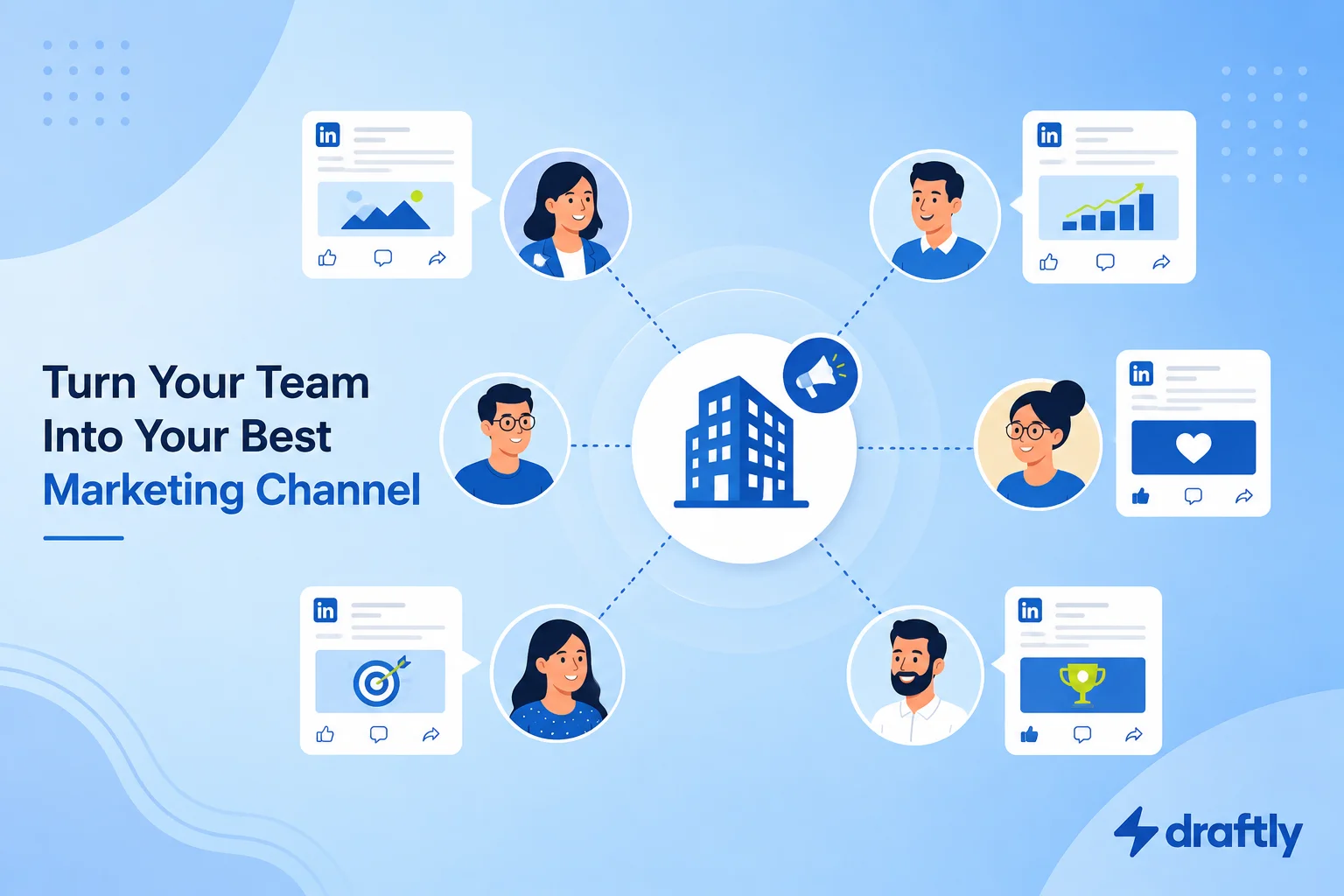
Employee advocacy is the practice of encouraging your employees to share, comment on, and create content related to your company on their personal LinkedIn profiles, rather than relying solely on your company page to carry the message.
It can look like:
- An employee resharing a company post with their own take added on top
- A team member writing an original post about a project they're proud of
- Leadership commenting thoughtfully on industry conversations and mentioning company work naturally
- Employees engaging with (not just posting) company and client content
The common thread: it's the employee's own voice, not a copy-pasted company message.
Takeaway: advocacy isn't about employees becoming unpaid marketers. It's about giving real expertise a bigger stage.
Why It Works Better Than Company Page Posts Alone
B2B buyers trust people more than they trust logos. A prospect scrolling LinkedIn is far more likely to stop on a post from someone who actually does the work than on a polished company announcement, and personal profiles simply reach further, since LinkedIn's algorithm favors content from individuals over brand accounts.
The numbers back this up. Industry data on employee advocacy programs has found employee-shared posts can generate multiples more engagement than the identical post shared from a company page, and a company's combined employee network is typically far larger in reach than its own follower count, often by an order of magnitude. Some studies have also tied employee-shared posts to meaningfully higher click-through rates than brand-only posts. The exact multiplier varies by industry and program maturity, but the direction is consistent across every study: people-powered distribution beats brand-only distribution.
This is exactly why advocacy is one of the core pillars of a solid LinkedIn B2B marketing strategy: it adds a layer of credibility that no amount of company-page polish can replicate. Every employee who posts becomes a distribution channel with their own trusted audience: recruiters see it, prospects see it, and industry peers see it.
Takeaway: your employees' combined networks are reach your company page will never have on its own.
LinkedIn's Native "Notify Employees" Feature: Where It Falls Short
LinkedIn has a built-in way to nudge your team: when you post from your company page, you can notify employees so it shows up as a suggestion in their own feed to reshare. It's a reasonable starting point, and it costs nothing.
But it has real limits. The native feature doesn't curate or suggest what to say when someone reshares, doesn't offer any analytics beyond basic post metrics, and doesn't help you recognize or motivate the employees who consistently show up. Most people need a bit of structure and confidence before they'll post about work on their own profile; a bare notification asking them to reshare rarely clears that bar.
That gap is exactly why dedicated advocacy tools exist, which we'll get to shortly. But you don't need one to start. You need a habit and a bit of enablement first.
Takeaway: the native "notify" button is a nudge, not a program. Treat it as step zero, not the whole strategy.
How to Start an Employee Advocacy Program (Without It Feeling Forced)
The fastest way to kill an advocacy program is to make it feel like homework. Here's how to build one people actually want to be part of:
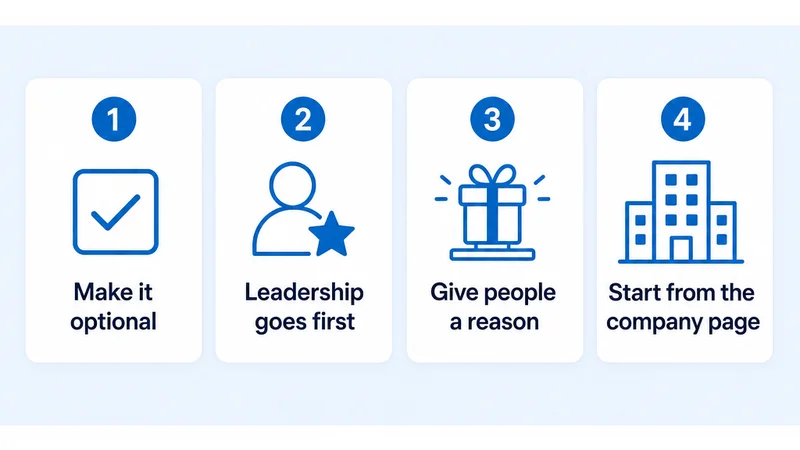
- Make participation easy, not mandatory. Provide optional, pre-written drafts employees can use as-is or tweak in their own voice. Never require a quota of posts: that's when advocacy starts feeling like unpaid marketing work.
- Get leadership to go first. If the program starts and ends with an email asking employees to "engage more," it won't work. When founders and managers visibly post and comment first, it signals that this is genuinely valued, not just requested.
- Give people a reason to want to participate. Employees share more when it benefits them: visibility for their own expertise, recognition in front of leadership, or simply pride in a project they shipped. Frame advocacy as something that builds their personal brand too, not just the company's.
- Start from your company page. A strong, active business page gives employees something worth resharing in the first place: job posts, product updates, and milestones they can genuinely be proud to put their name next to.
Takeaway: the programs that work are optional, modeled from the top, and genuinely useful to the employee, not just the brand.
What to Ask Employees to Share
Not every post needs to be a full company announcement. Some of the easiest, highest-performing advocacy content includes:
- Behind-the-scenes project wins: "here's what we shipped and why it mattered"
- Job openings: employees sharing roles reach far more qualified candidates than a careers page ever will
- Reactions to company milestones: a funding round, a product launch, a customer win
- Personal takes on industry topics that naturally reference company work
- Event recaps: a conference, webinar, or client meeting worth a quick post
Here's a simple prompt you can hand an employee who isn't sure where to start:
"Share one thing you learned or built this month, and mention how it ties back to what we're doing as a team. One paragraph is enough. You don't need a polished essay."
Takeaway: the best advocacy content doesn't sound like marketing. It sounds like a person talking about their actual work.
The Recruiting Upside Nobody Talks About
Employee advocacy usually gets pitched as a marketing tactic, but it quietly does just as much for hiring. When employees post about the work itself, not a scripted "we're hiring" announcement, it gives candidates a real look at the team and culture before they ever apply. Research on employer branding has consistently linked active employee advocacy to stronger recruiting outcomes, including higher-quality inbound candidates and referrals.
A single employee sharing "here's what shipping this feature actually looked like" does more for recruiting than a polished careers page, because it's proof, not a pitch.
Takeaway: treat advocacy as a recruiting channel too, not just a content-distribution one. It often pays off there first.
How to Measure Whether It's Working
Advocacy is harder to track than a single company post, but it breaks down cleanly into three tiers:
Participation signals: are people actually doing it? Track how many invited employees ever post (adoption), and how many keep posting month over month (active participation). A program where adoption trails off after the first week isn't broken; it's usually just missing ongoing prompts or recognition.
Engagement signals: is it landing? Watch combined reach and engagement rate across employee posts compared to the company page alone, and note which content types (project stories, milestones, industry takes) consistently outperform the rest so you can ask for more of those.
Business signals: is it moving the numbers that matter? Referral traffic to your site, inbound leads or candidates that mention "saw a post from your team," and profile views or connection requests for participating employees are the clearest signs advocacy is doing real work, not just generating likes.
Most teams don't need a dedicated advocacy platform to track this. A handful of the tools in this LinkedIn marketing tools roundup already cover the analytics side. You're mainly looking for whatever helps you see engagement trends over time, not a specialized advocacy suite, at least while the program is still small.
Takeaway: track participation and business impact, not just how many people technically joined the program.
When to Consider a Dedicated Advocacy Platform
Once a program grows past a handful of consistent posters, spreadsheets and manual reminders stop scaling. That's when purpose-built advocacy tools start earning their cost: they typically add a shared content library employees can post from with one click, built-in analytics that isolate advocacy's impact from the rest of your social activity, and light gamification (leaderboards, recognition) to keep momentum going past the first month.
A few well-known names in this space, for reference if you get to that point: GaggleAMP and Haiilo are built specifically around structured advocacy and content libraries; Sociabble and Hootsuite's Amplify add advocacy features on top of broader social management suites. None of these are Draftly products. They're worth knowing about once you outgrow a DIY approach, not a starting requirement.
Takeaway: start manually with a handful of engaged employees; only add dedicated software once the manual version is working and you need to scale it.
Common Employee Advocacy Mistakes to Avoid
- Mandating a posting quota. This is the single fastest way to make advocacy feel like an obligation instead of an opportunity.
- Only asking, never modeling. If leadership doesn't participate visibly, employees notice.
- Handing people a script with no room to personalize. Word-for-word reshares read as inauthentic and get less engagement than a rewritten version in the employee's own voice.
- Skipping basic guidelines. A short, simple set of dos and don'ts (what not to share publicly, when to loop in a manager) prevents awkward mistakes without turning the program into a compliance exercise.
- Measuring only volume. Ten low-effort reshares are worth less than two thoughtful posts that spark real conversation.
Takeaway: advocacy fails when it feels mandatory and succeeds when it feels optional, guided, and genuinely useful.
Conclusion
Employee advocacy works because it replaces a single company voice with dozens of trusted, individual ones, and B2B buyers respond to people, not logos. Start small: make participation optional, give employees an easy on-ramp, and have leadership go first.
If you want your team's posts to consistently look polished without turning advocacy into extra work for anyone, Draftly's free plan can help each employee draft and schedule posts in minutes instead of starting from a blank page.