Most B2B buyers now research a company on LinkedIn before they ever fill out a contact form. If your brand isn't showing up there with a clear, credible presence, you're losing deals before your sales team even knows they existed.
LinkedIn has quietly become the default research destination for B2B buyers, and that makes it one of the highest-leverage channels a B2B marketing team can invest in. But "being active on LinkedIn" and "running a real LinkedIn B2B marketing strategy" are two very different things.
This guide breaks down what LinkedIn B2B marketing actually means, why it matters more in 2026 than it did a year ago, and how to build a strategy that covers your company page, your content, your ads, and the people who work for you.
What Is LinkedIn B2B Marketing
LinkedIn B2B marketing is the practice of using LinkedIn's company pages, organic content, employee networks, and advertising tools to reach other businesses, generate leads, and build brand authority with decision-makers.
Unlike consumer social platforms, LinkedIn's entire audience is built around professional identity: job titles, industries, company size, and seniority. That's exactly the targeting data a B2B marketer needs. It's why B2B teams treat LinkedIn less like a "social media channel" and more like a combined brand, content, and pipeline tool.
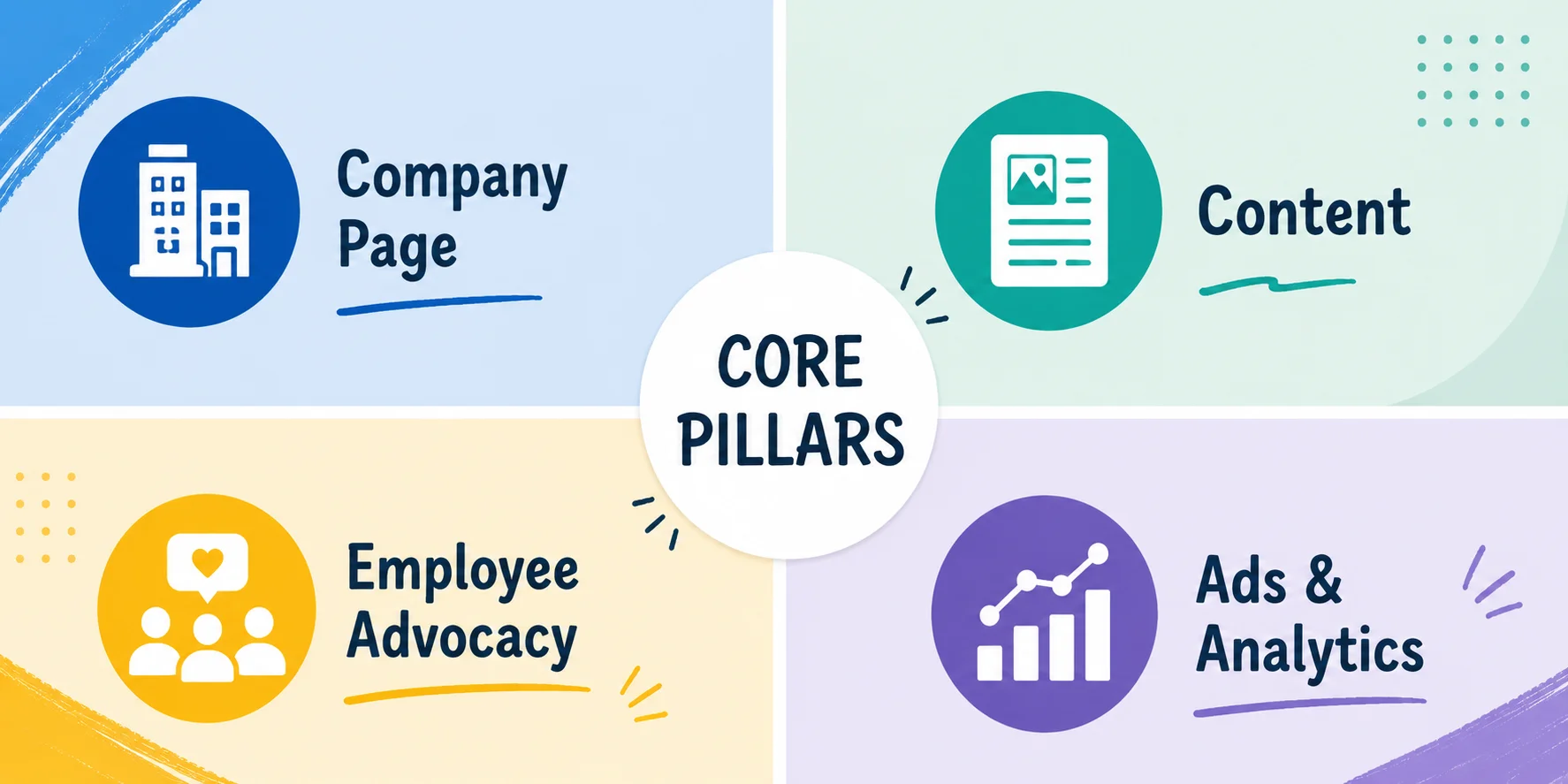
A real LinkedIn B2B marketing strategy usually pulls together four things working at once: an optimized company presence, a consistent content engine, employees who amplify that content, and paid campaigns that put your best material in front of the right buyers.
Why LinkedIn Matters for B2B Marketing in 2026
LinkedIn's core advantage hasn't changed: it's still the platform with the deepest access to decision-makers and industry professionals in one place. With well over 65 million decision-makers active on the platform, it remains one of the few channels where you can reliably reach the people who actually sign off on B2B purchases.
What has changed is the level of competition. More B2B teams are publishing on LinkedIn than ever, which means a generic company page or an inactive feed gets buried fast. The brands winning attention in 2026 are the ones treating LinkedIn as a full-funnel channel, not a place to occasionally cross-post a press release.
That shift matters because LinkedIn now influences buying decisions earlier in the funnel. Prospects check out your company page, skim your recent posts, and look at how your employees talk about the company long before they talk to sales. A thin or outdated presence quietly costs you credibility at exactly the moment you're trying to earn it.
Takeaway: if your LinkedIn presence looks abandoned, that's the impression prospects walk away with, regardless of how good your product actually is.
Start With the Foundation: Your LinkedIn Business Page
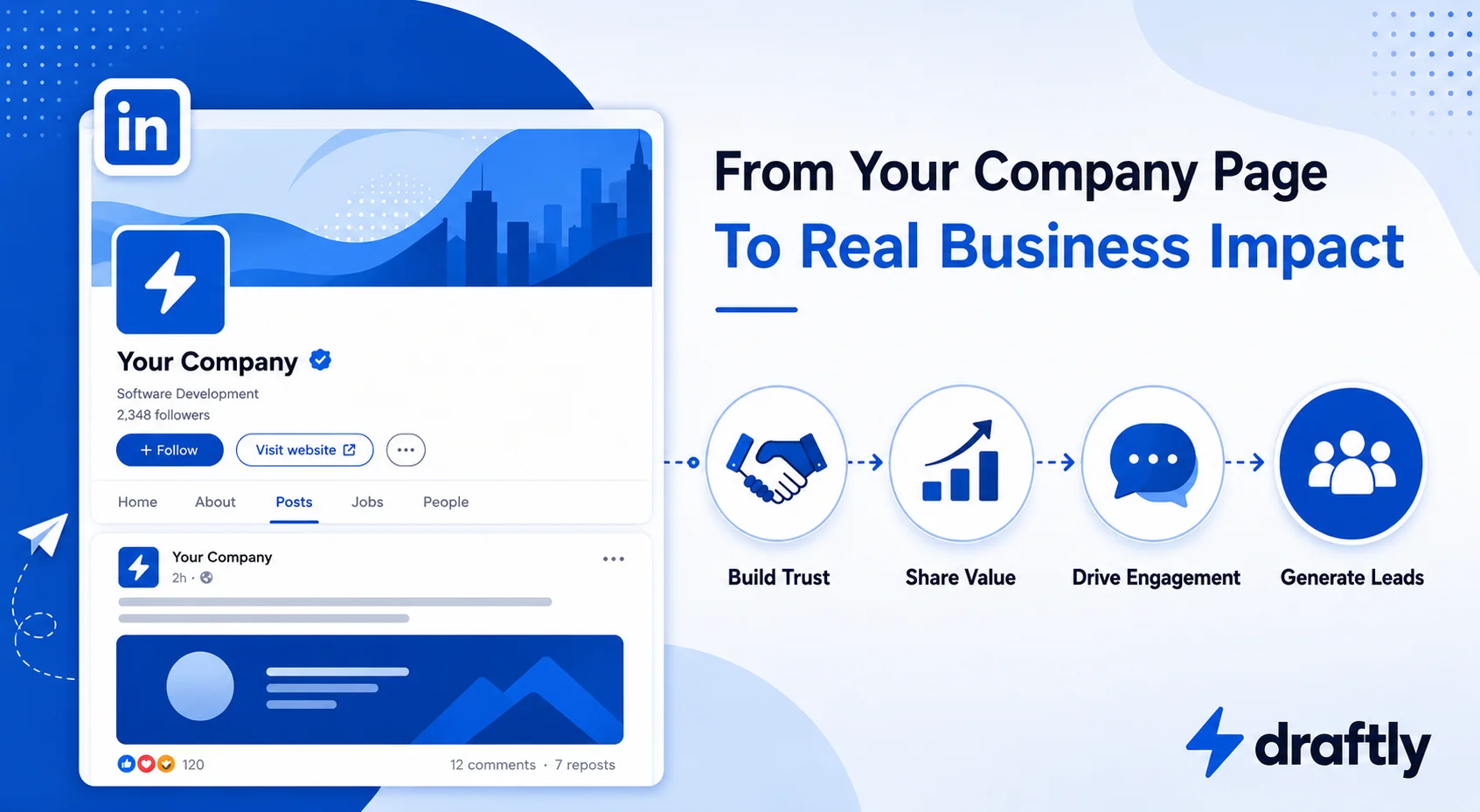
Every LinkedIn B2B marketing strategy is built on top of a company page, so this is the part to get right first. Your page is your digital storefront: it's often the first thing a prospect checks after a cold email or a sales call.
If you haven't set one up yet, start by creating a LinkedIn business page, from choosing a page type to writing an About section that actually converts.
Once your page exists, a few fundamentals separate a credible B2B presence from a forgettable one:
A complete profile. Logo, banner, industry, company size, and a keyword-rich About section that explains what you do and who you help.
A clear call-to-action button, such as "Visit Website" or "Contact Us," pointed at a page built to convert.
A posting cadence, even a modest one, so the page doesn't look dormant to anyone checking it out.
Showcase pages, if you sell multiple products or serve distinct segments that each need their own narrative.
Getting the page right isn't a one-time task, either. It's the base your content, ads, and employee advocacy all build on.
The Core Pillars of a LinkedIn B2B Marketing Strategy
Once your page is in shape, the actual strategy comes down to four connected pillars: content, employee advocacy, paid ads, and analytics.
1. A Consistent B2B Content Strategy
Content is what makes your page feel alive between sales conversations. For B2B specifically, the content that earns attention tends to fall into a few buckets: thought leadership on industry trends, case studies that show real outcomes, product updates framed around a customer problem, and short, opinionated posts that spark discussion in the comments.
A quick mini-script you can adapt for a thought-leadership post opener:
"Everyone in [industry] is talking about [trend]. Here's the part nobody mentions: [contrarian or overlooked insight]."
That structure works because it takes a stance instead of just restating what a prospect already knows.
Want a deeper breakdown of formats, targeting, and how to pair organic posts with paid promotion? We've covered how to build a B2B brand on LinkedIn using content in more detail.
If writing consistently is the bottleneck, a tool like Draftly's LinkedIn post generator can help you turn a rough idea into a publish-ready draft in a couple of minutes, so a busy week doesn't turn into a two-week content gap.
2. Employee Advocacy
B2B buyers trust people more than they trust logos. A post from your VP of Sales or a customer success lead almost always outperforms the same message posted from the company page, simply because it comes with a face and a name attached.
Employee advocacy works best when it's easy, not mandatory. Give your team pre-written post drafts they can tweak, share company posts with a personal note, and encourage leadership to comment on industry conversations under their own name rather than the brand's. Employees who invest in their own personal brand on LinkedIn end up extending your company's reach for free, just by showing up consistently as themselves.
3. LinkedIn Ads for B2B
Organic content builds trust, but ads are what let you put your best material in front of buyers who don't already follow you. LinkedIn's targeting is the reason B2B teams pay a premium for it: you can filter by job title, seniority, company size, and industry, which is far more precise than most other ad platforms allow.
A few formats do most of the work for B2B campaigns:
Sponsored Content for boosting a strong organic post or article to a colder audience.
Message Ads for personalized offers or event invites that land directly in a prospect's inbox.
Text Ads for lower-cost, high-volume traffic to a landing page.
Start small. Run a limited test budget against one tightly defined audience before scaling spend, and track cost-per-click and conversion rate rather than vanity metrics like impressions.
4. Analytics and Optimization
None of the above matters if you're not checking what's working. LinkedIn's native analytics show engagement, reach, and click-through data at the post and page level, which is enough to spot patterns: which topics land, which formats get shared, and which posts quietly flop.
Review this monthly, not daily. Look for the two or three post types that consistently outperform the rest, and shift more of your content calendar toward them.
A Realistic LinkedIn B2B Marketing Example
Here's what this looks like stitched together in practice: a B2B SaaS company posts a customer case study on its company page. The account exec who worked that deal shares it with a short personal note about why the win mattered. The marketing team boosts the original post as Sponsored Content targeted at similar job titles at similar-sized companies. A week later, analytics show the case study outperformed the last three product update posts, so the next quarter's content calendar leans harder into customer stories.
That's the whole loop: company page as the base, content as the hook, employees as the amplifier, ads as the reach multiplier, and analytics as the feedback loop that tells you what to do more of.
Common LinkedIn B2B Marketing Mistakes to Avoid
A few patterns show up again and again in B2B pages that struggle to gain traction:
Treating LinkedIn like a press release feed. Company announcements alone rarely earn engagement. Mix in perspective, not just news.
Ignoring the comments section. Engagement compounds when you actually reply to people who comment, not just when you post.
Running ads without a warmed-up page. Sending cold traffic to a company page with three outdated posts undercuts the ad spend behind it.
Relying on one person to carry all the content. If your entire LinkedIn presence depends on one founder's posting habit, it collapses the moment they get busy. Spread the load across a few voices.
Tools to Streamline Your LinkedIn B2B Marketing
Consistency is the hardest part of any LinkedIn B2B marketing strategy to maintain, especially once the initial push fades. This is where having the right tools in place makes a real difference:
A post generator you actually trust, so a rough idea turns into a draft in your brand's voice instead of sitting in a notes app for a week.
Scheduling tools keep your page active even during weeks when your team is heads-down on other priorities.
Native LinkedIn analytics for the monthly review of what content and ad formats are actually converting.
Pairing the right tools with the four pillars above is what turns "we're on LinkedIn" into a strategy that reliably brings in pipeline.
Conclusion
LinkedIn B2B marketing works when your company page, content, employees, and ads all reinforce the same story instead of operating in isolation. Start with a fully optimized page, build a content rhythm your team can sustain, get your employees involved, and use analytics to double down on what's actually working.
If writing and scheduling consistent LinkedIn content is the piece you keep putting off, Draftly can help you turn ideas into publish-ready posts and keep your company's presence active without adding hours to your week.