There was a time when every serious professional needed a personal website. You bought a domain, chose a theme, added a headshot, a few testimonials, maybe a contact form, and called it your personal brand. That model still works, but buyer behavior has changed.
Today, when someone hears your name on a podcast, sees your comment under a viral post, or receives your email, they rarely stop at your website. They search for you on LinkedIn. And increasingly, that is where the real evaluation happens.
This shift is not hype. It reflects how professionals verify credibility in a networked environment.
Let’s examine why LinkedIn profiles are increasingly replacing traditional landing pages, particularly for consultants, founders, operators, recruiters, and B2B professionals.
LinkedIn Is the First Credibility Checkpoint
When someone considers hiring you, partnering with you, investing in you, or even replying to your message, they want context. They are asking:
- Who is this person?
- What have they actually done?
- Do credible people interact with them?
- Are they active and current?
A static landing page answers some of these questions. A LinkedIn profile answers more of them, and in a more socially validated way.
A LinkedIn profile displays work history with timestamps, real company names, mutual connections, endorsements, recommendations, and visible activity. Engagement from other professionals acts as layered social proof. A landing page communicates what you say about yourself; LinkedIn shows how the professional ecosystem responds to you. That distinction significantly influences perceived trust.
It Combines Resume, Portfolio, and Social Proof
Most landing pages are built for a single objective: book a call, download a resource, purchase a course, or submit a form. They are optimized for conversion.
LinkedIn profiles are optimized for credibility.
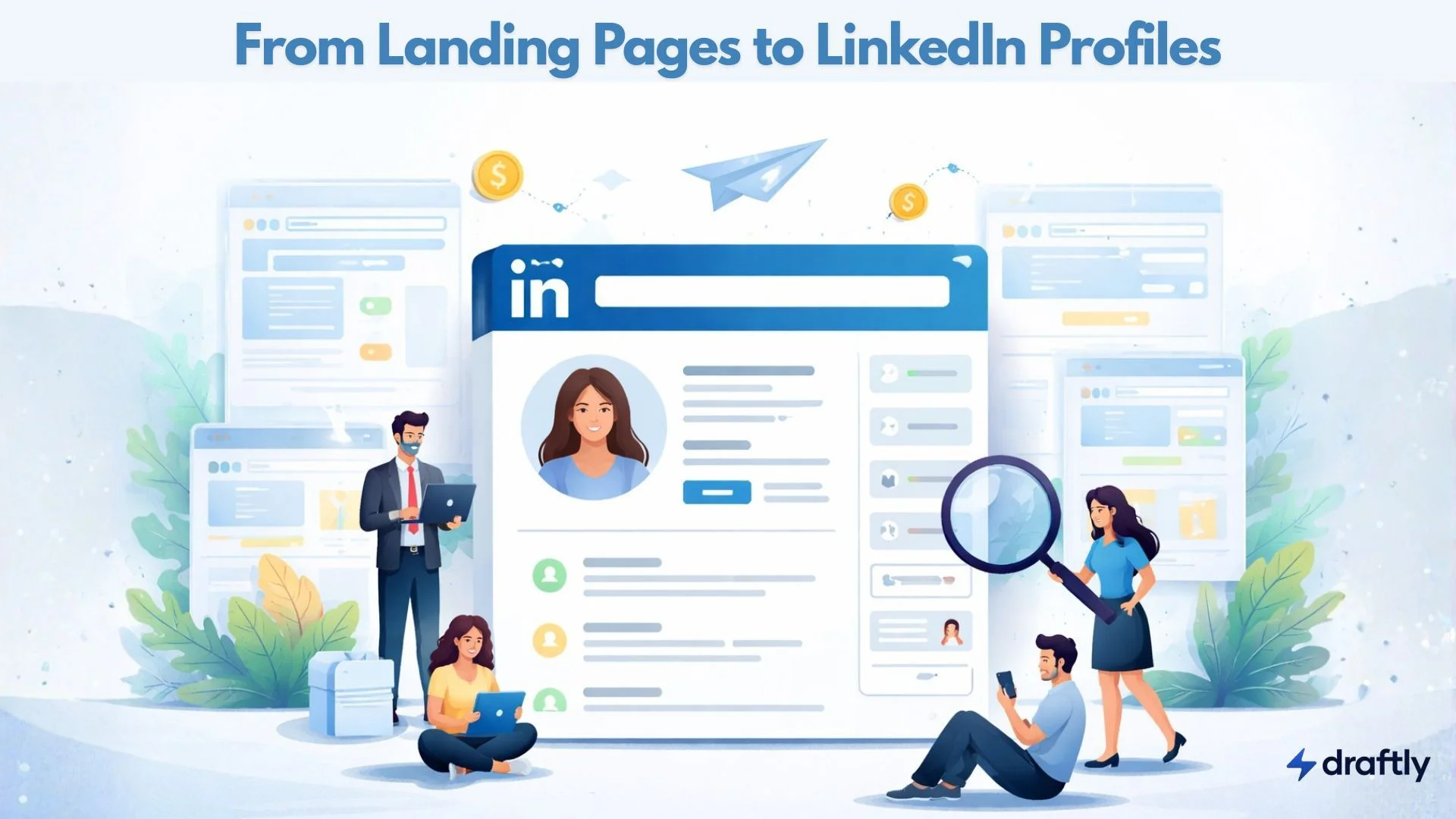
In one scroll, a visitor can see your headline positioning, narrative summary, experience, skills, featured links, recommendations, posts, comments, and engagement. It functions as a living professional record rather than a static marketing page.
Unlike a website that may go unchanged for months, a LinkedIn profile evolves each time you publish a post, contribute thoughtfully to discussions, receive a recommendation, or update a role. That ongoing activity signals relevance and professional momentum. A landing page may look polished, but LinkedIn demonstrates current participation in your industry.
The Built-In Visibility Engine
When someone visits a personal website, the interaction typically ends there. There is no embedded network effect.
LinkedIn, however, operates through compounding visibility. Consistent posting increases feed exposure, extends reach to second- and third-degree connections, and drives recurring profile visits. Over time, your name becomes familiar to your audience.
Familiarity reduces friction in professional decision-making. Instead of encountering you once through a website, prospects see your thinking repeatedly within their feed. That repeated exposure builds recognition and lowers skepticism in ways a standalone landing page cannot replicate.
Search Advantage: External and Internal
LinkedIn profiles are indexed by search engines and frequently rank highly for personal name searches. In many cases, your LinkedIn profile appears above your personal website in search results. When that happens, it becomes the default destination for evaluation.
Beyond external search, LinkedIn’s internal search engine captures intent directly within the platform. Professionals search for terms such as:
- SaaS marketer
- B2B copywriter
- Demand generation consultant
- Startup CFO
If your headline, summary, and experience sections reflect those keywords clearly, your profile becomes discoverable within LinkedIn’s ecosystem. A standalone landing page does not benefit from that built-in professional search network.
Lower Friction and Higher Perceived Safety
Clicking a stranger’s website often triggers subtle caution. Visitors assess URL legitimacy, design quality, and brand familiarity before engaging further.
On LinkedIn, the trust barrier is lower. Profiles are tied to real identities and visible networks. Mutual connections are displayed. Messaging occurs within a known platform environment. This reduces perceived risk.
In B2B settings, this difference matters. Professionals may hesitate to complete a form on an unfamiliar site, yet feel comfortable sending a LinkedIn message. That reduction in friction increases response rates and accelerates conversations.
Maintenance and Agility
Maintaining a website requires hosting, domain management, design updates, CMS familiarity, and technical upkeep. For many independent professionals, this becomes a background task that is easily neglected.
LinkedIn requires far less infrastructure. Updating positioning, rewriting a headline, adding a banner, or adjusting your service description takes minutes. If you pivot your offer or refine your niche, the change can be reflected immediately without developer involvement.
For consultants and operators who iterate frequently, that agility is practical and strategically valuable.
Offline Networking Now Points to Profiles
Professional networking habits have evolved alongside digital behavior. Business cards, conference badges, presentation slides, and even email signatures increasingly link directly to LinkedIn profiles rather than personal websites. QR codes now act as instant bridges between offline interactions and online credibility.
Many professionals use tools like a Best QR Generator - Uniqode to create clean, scannable codes that direct contacts straight to their LinkedIn profile. Instead of expecting someone to remember a domain name and look it up later, a quick scan immediately opens a full professional overview.
When someone scans your profile after a conference conversation, they see your work history, shared connections, recommendations, and recent activity in one place. That layered, real-time context often feels more reassuring than landing on a minimal website with limited visible social proof.
Conversations Happen in Public
Landing pages are largely one-directional. You present information; visitors consume it.
LinkedIn enables public interaction. When you comment thoughtfully on industry discussions or publish insights that generate engagement, others observe your reasoning in real time. By the time someone visits your profile, they may already have seen how you think.
This contextual exposure shortens evaluation cycles. Prospects are not encountering you cold; they have already observed your expertise within visible conversations.
B2B Decisions Require Context
In B2B environments, purchasing decisions are rarely impulsive. Buyers review mutual connections, shared experiences, prior roles, recommendations, and content quality before initiating serious discussions.
LinkedIn consolidates this context without requiring multiple tabs or external verification. While landing pages can display testimonials, LinkedIn recommendations are attached to real, verifiable profiles. That structural transparency increases perceived authenticity.
Recruiters demonstrate this behavior clearly. Many search and evaluate directly within LinkedIn, reviewing endorsements, activity, and network overlap before ever requesting a resume or personal website.
Landing Pages Still Have a Role
This shift does not make landing pages obsolete. They remain essential for:
- Paid advertising campaigns
- Product sales funnels
- SaaS onboarding flows
- Lead capture via custom forms
- A/B testing and performance tracking
- E-commerce transactions
LinkedIn profiles are not designed to process payments, host gated content, or optimize conversion experiments. For scalable product businesses, dedicated landing pages remain critical.
However, for individuals building reputation and inbound opportunity, LinkedIn increasingly shapes first impressions.
The Core Driver: Trust
At the center of this shift is trust.
Trust signals on LinkedIn include visible work history, shared connections, recommendations, consistent activity, and engagement from identifiable professionals. These elements are difficult to replicate convincingly on a static website.
A landing page can present credibility claims. LinkedIn displays social validation attached to real identities. In an environment where professionals routinely verify and cross-check information, that distinction matters.
Platform-Centered Personal Branding
A decade ago, owning a domain symbolized digital legitimacy. Today, attention is concentrated on platforms. LinkedIn remains one of the few environments where professional identity is central, long-form content is supported, direct outreach is normalized, and business conversations are expected.
As a result, a LinkedIn profile functions simultaneously as:
- A credibility page
- A content archive
- A conversation gateway
- A networking hub
That multifunctional design gives it strategic leverage beyond what a static landing page typically offers.
What Makes a LinkedIn Profile Replace a Landing Page Effectively?
Not every profile serves as a strong replacement. To function as a credibility hub, it should include:
1. A Clear, Value-Driven Headline Move beyond job titles. Articulate who you help and what outcome you deliver. Clarity consistently outperforms clever phrasing.
2. A Structured About Section Explain what you do, who you serve, the problems you solve, and how to contact you. Treat this section as a homepage copy rather than a resume summary.
3. A Strategic Featured Section Add case studies, media mentions, portfolio samples, certifications, or scheduling links. This area can mirror a landing page’s call-to-action zone.
4. Consistent Activity Regular posting or thoughtful commenting signals relevance and engagement. Frequency matters less than sustained presence.
The Hybrid Model Is Often Optimal
For many professionals, the most effective strategy is not choosing one over the other. LinkedIn can serve as the credibility layer, while a website operates as the conversion engine.
In this model:
- LinkedIn builds awareness and trust.
- The website captures leads and explains services in depth.
- Email nurtures long-term relationships.
If resources are limited, LinkedIn often delivers faster visibility because it leverages an existing professional network rather than relying solely on external traffic acquisition.
Why This Trend Is Likely to Continue
Several structural factors support the continuation of this shift:
- Professional identity is already concentrated on LinkedIn.
- Recruiters and B2B buyers are comfortable evaluating within the platform.
- Social proof is dynamic and continuously updated.
- Profiles are easier to maintain than standalone websites.
- Platform-based discovery continues to expand.
Personal websites will remain relevant, but the first checkpoint for professional evaluation increasingly lives on LinkedIn.
Final Thoughts
Traditional landing pages are not disappearing. However, for many professionals, they are no longer the primary credibility asset.
A LinkedIn profile is searchable, socially validated, dynamic, easier to maintain, and integrated directly into ongoing professional conversations. In many cases, it becomes the first meaningful impression.
When someone searches your name, they are not just looking for a polished design. They are looking for evidence of relevance, participation, and trust.
For a growing number of consultants, founders, and operators, LinkedIn is no longer just a networking platform. It is the central node of their professional identity.
Frequently Asked Questions
For many B2B professionals, yes. LinkedIn is often the first place people check for credibility, experience, and social proof. Websites still matter, but LinkedIn usually shapes the first impression.